
Columbus property managers receive dozens of metal roof restoration proposals during the spring bidding season, but qualification gaps create expensive problems. Coating failures from unqualified applicators cost three times the original investment when interior damage and re-mobilization are factored in. Finding a qualified commercial roof coating contractor in Columbus, OH requires credential verification that separates legitimate professionals from those who simply own spray equipment. Top Notch Commercial Roofing recognizes that proper credentials determine whether you get 15 years of protection or face failure within three seasons. This framework covers manufacturer certifications, insurance requirements, and performance documentation that property managers should demand before signing contracts.
Which Metal Roof Coating Systems Are You Certified to Install?
Metal roof coatings differ fundamentally from flat roof applications due to substrate reactivity and corrosion chemistry. A commercial roof coating contractor in Columbus, OH must carry manufacturer certifications demonstrating competency with these challenges.
Coating manufacturers structure certifications in progressive tiers: Approved Applicator (basic training), Certified Contractor (proven project completion), and Elite/Platinum Partner (multi-year performance record). Each tier unlocks different warranty coverage levels. When evaluating any metal roofing contractor in Columbus, Ohio, verify certification tier since this directly impacts warranty protection. A metal roof coating company at the Elite tier delivers manufacturer-backed warranties that Approved Applicators cannot offer.
Silicone coatings behave differently on galvanized steel than aluminum. Acrylic systems require different surface preparation than polyurethane formulations. Qualified contractors complete separate training for each coating chemistry and metal substrate combination.
Verify certifications through three steps: request certification documentation from the contractor, contact the manufacturer’s commercial division directly, and confirm current certification status and tier level. These are the same verification steps Top Notch Commercial Roofing recommends property managers use across all vendor evaluations.
| Coating Manufacturer | Certification Requirements | Verification Contact | Recertification |
| Gaco Western | 16-hour training + audit | 800-331-0196 | Every 2 years |
| Karnak | Product-specific training | 732-388-0300 | Annual |
| Mule-Hide | 2-day installation course | 800-786-1492 | Every 3 years |
| Tremco | Regional training + review | 800-321-7906 | Every 2 years |
Watch for contractors claiming “certification for all systems” without specifying manufacturers. Coating manufacturers don’t cross-certify, meaning authorization for one brand doesn’t qualify a commercial metal roofing company to apply another manufacturer’s product.
Call manufacturers directly—never rely solely on contractor-provided certificates. Request verification of certification status, tier level, restriction notes, and geographic limitations. Legitimate metal roofing contractors expect this verification and provide manufacturer contact information proactively.
What Rust and Corrosion Assessment Methods Do You Use Before Specifying a Coating?
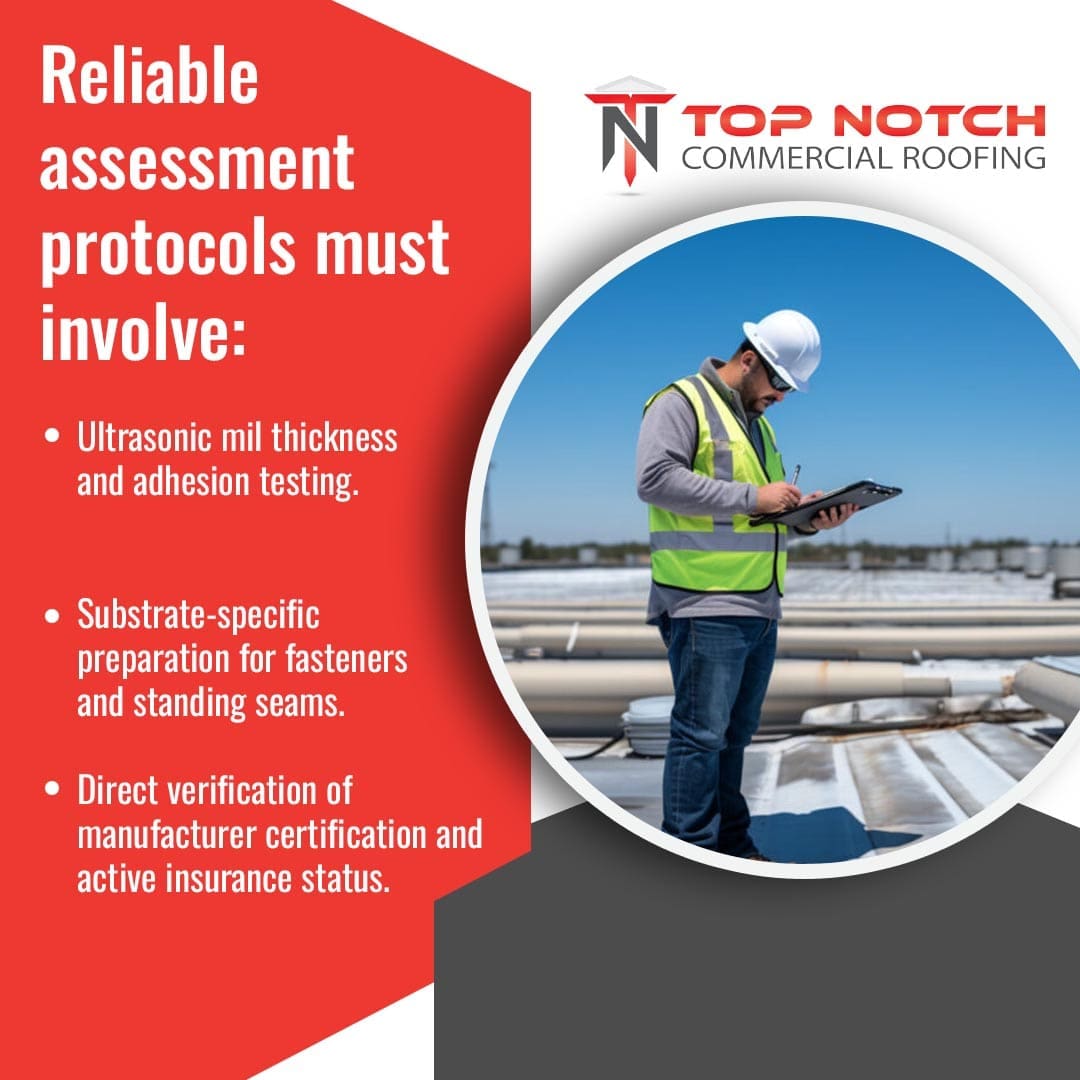
Coating failures often trace to inadequate pre-application assessment. Qualified teams of metal roofing contractors in Columbus, Ohio, employ specific testing protocols to determine whether coating is appropriate or structural repairs come first.
Standard Assessment Protocol
Contractors should use three distinct testing methods before recommending any coating approach:
- Mil thickness testing – Ultrasonic gauges measure remaining metal thickness at suspect locations, identifying where corrosion has reduced structural capacity
- Adhesion testing – Pull-off testing determines if existing coatings or rust scale will bond properly with new layers
- Ferrous metal identification – Different metals require different coating systems and preparation methods
Rust Classification Standards
Industry standards establish clear thresholds that determine appropriate restoration approaches:
- Surface rust (affects <25% of metal thickness) – Responds to proper surface preparation and coating application
- Moderate corrosion (affects 25-50% of thickness) – Requires localized panel replacement before any metal roof repair begins
- Severe corrosion (affects >50% of thickness) – Necessitates complete panel replacement rather than coating
Ohio Climate Impact
Columbus freeze-thaw cycles accelerate corrosion progression in ways contractors from mild climates often miss. According to the Great Lakes Integrated Sciences + Assessments program at the University of Michigan, Ohio experiences significant freeze-thaw cycling where surface rust can progress to structural corrosion within 18-24 months.
Water infiltration into rust layers freezes, expands, and lifts rust scales that appear stable during dry conditions. Property managers searching for “metal roofing near me” should specifically request assessment protocols addressing freeze-thaw impact on rust progression.
Replacement Thresholds
Qualified metal roof restoration contractor teams recognize when replacement becomes necessary rather than coating. These critical thresholds include:
- Rust affecting more than 30% of the total roof surface area
- Multiple penetration locations showing active interior leaks
- Panel sections with complete perforation where daylight penetrates from the interior
- Fastener pattern areas where corrosion has compromised the deck attachment
Manufacturer warranties void coverage when coating is applied over substrates not meeting minimum condition standards. Improper assessment leaves property managers bearing the full costs of failed coating work and the necessary structural repairs that should have been completed initially.
What Insurance Coverage Protects Me During and After Metal Roof Restoration?
Insurance requirements for commercial metal roofing company projects extend beyond generic liability policies. Property managers need specific coverage addressing spray-applied coating risks on occupied buildings.
Ohio mandates minimum insurance: general liability ($1M per occurrence, $2M aggregate), workers’ compensation (statutory limits), and commercial auto ($1M combined limit). Complex projects require higher limits based on building value and project scope.
Additional insured endorsements extend coverage to property owners, protecting against claims where contractor work creates owner liability. Request certificates specifically naming your property entity—avoid generic “property owner” language. When evaluating metal roofing contractors, verify coverage limits match actual risk exposure.
Completed operations coverage protects against claims from defects discovered after the metal roof coating company leaves. This addresses coating failure causing interior damage months later, improperly sealed penetrations damaging HVAC systems, or drainage modifications creating structural issues. Verify coverage remains active for a minimum of two years post-project.
| Coverage Type | Minimum Limits | Protection Scope | Duration |
| General Liability | $2M aggregate | Property damage, bodily injury | Project + 2 years |
| Workers’ Comp | Ohio statutory | Employee injuries | During project |
| Completed Operations | $1M per occurrence | Post-project failures | 2-5 years post |
| Equipment Coverage | $500K minimum | Spray equipment damage | During project |
Certificate verification requires calling insurance companies directly using numbers from their websites. This approach aligns with the documentation standards followed by Top Notch Commercial Roofing on every commercial project.
Provide policy numbers and verify active coverage, catching outdated certificates or lapsed coverage. Many contractors use subcontracted labor—each subcontractor should carry insurance meeting the same standards, since your exposure exists regardless of contractor relationships.
Can You Show Before/After Projects with Measured Energy Savings?
Energy savings claims drive many metal roof repair decisions, but gaps between promises and measured results create ROI disappointment. Qualified contractors document performance using measured data from comparable projects rather than manufacturer maximums.
Legitimate documentation includes four data points: pre-coating roof temperature via IR thermography, post-coating temperature 60 days later at identical conditions, 12-month utility comparison with weather normalization, and confirmation that occupancy and HVAC remained stable.
Research at Oak Ridge National Laboratory examining metal roofs with reflective coatings found substantial energy savings. Studies funded by the U.S. Department of Energy found reflective coatings deliver up to 25% cooling cost reductions when properly applied. Property managers evaluating nearby metal roofing options should expect documentation reflecting these realistic ranges.
| Building Type | Coating System | First-Year Savings | ROI Timeline |
| Warehouse (unconditioned) | White silicone | 12-18% | 7-9 years |
| Distribution center | Cool roof acrylic | 18-25% | 5-7 years |
| Manufacturing facility | High-SRI silicone | 15-22% | 6-8 years |
| Office building | Reflective coating | 20-28% | 4-6 years |
Variables affecting results include existing roof color, HVAC efficiency, insulation levels, internal heat load, and operation hours.
Legitimate metal roof installation contractors document projects showing building details, coating specifications, energy measurement protocol, and measured results with temperature reduction, energy reduction percentage, annual savings, project cost, and ROI calculation. Red flags include no weather normalization, cherry-picked time periods, uncontrolled variables, manufacturer maximum claims, and no baseline documentation.
Request raw utility data and measurement protocols rather than summary percentages. Legitimate contractors share this, knowing that documented results sell better than unsupported claims.
How Do You Handle Penetrations, Fasteners, and Seam Details?
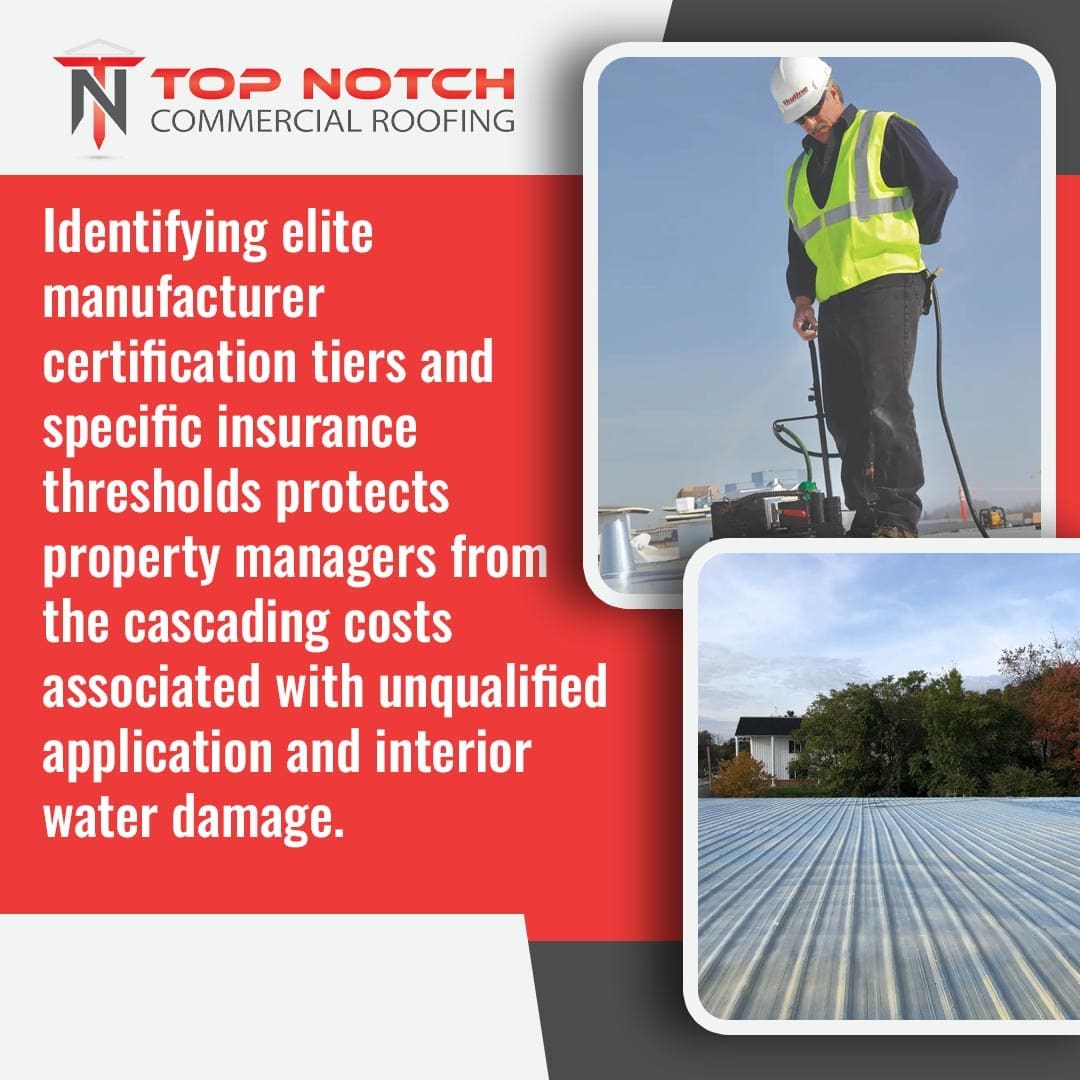
Field coating is straightforward—failures concentrate at details where penetrations, fasteners, and seams require specialized treatment, separating qualified metal roofing contractors from those taking shortcuts.
Fastener Treatment Protocol
Through-fastened roofs contain thousands of exposed fasteners where water infiltration risk concentrates. Each fastener requires individual attention:
- Power wire brush prep to remove rust and create mechanical tooth
- Rust-inhibitive primer application around and over the fastener head
- Polyurethane or silicone sealant cap creating a watershed profile
- Field coating overlap by a minimum of 2 inches, integrating the fastener into the membrane
Contractors skipping fastener-specific treatment create primary failure points in otherwise sound systems. Budget proposals should include separate line items for fastener treatment, indicating that the commercial roof coating contractor in Columbus, OH, recognizes this as distinct labor from field application.
Seam Treatment Differences
Standing seam and through-fastened systems require completely different approaches based on panel connection methodology.
Standing Seam Treatment:
- Clean the seam area with a solvent wipe
- Apply a continuous bead of lap sealant along the full length
- Embed reinforcing fabric in wet sealant
- Tie fabric into the field coating, creating a continuous membrane
Through-Fastened Treatment:
- Seal lapped panel edges with polyurethane sealant
- Address each fastener individually in the lap area
- Apply reinforcing fabric over the entire lap width
- Integrate fabric edges with field coating
Penetration Flashing Requirements
Roof penetrations interrupt the continuous coating membrane and require multi-layer flashing details:
- Clean metal-to-curb interfaces, removing debris
- Prime all metal surfaces and curb materials
- Apply base coat extending 6″ onto the curb and 12″ onto the field
- Embed reinforcing fabric in the wet base coat
- Apply the finish coat, tying the detail into the field system
Different penetrations require different fabric widths and overlap dimensions. HVAC curbs need wider tie-ins than small pipe penetrations. Contractor proposals should detail the treatment protocol for each penetration category present on your roof.
Material Compatibility Chart
| Substrate Type | Compatible Sealant | Compatible Coating | Incompatible Combinations |
| Galvanized steel | Polyurethane/Silicone | Silicone/Acrylic | Asphalt-based + Silicone |
| Pre-painted metal | Silicone preferred | Silicone | Acrylic sealant + Acrylic coating |
| Aluminum | Silicone only | Silicone | Polyurethane sealant |
| Stainless steel | Neutral-cure silicone | Silicone | Acidic cure sealants |
Material compatibility failures cause delamination at detail locations even when the field coating remains fully adhered and performing properly. The sealant-to-coating interface must use chemically compatible materials, or mechanical bond failure occurs within months.
Addressing Drainage Issues
Metal roofs develop slight sags over time where panels deflect between structural members, creating low areas that collect water after rainfall. Qualified metal roof restoration contractor teams address drainage before coating application:
- Identify low spots through a roof survey during dry conditions
- Modify panel slopes using panel replacement or structural support addition
- Install additional drains or scuppers, eliminating ponding areas
- Avoid coating over areas where standing water will persist beyond 48 hours
Coating manufacturers void warranties on roof areas subject to ponding water exceeding 48 hours duration. Contractors who coat over known ponding areas without drainage correction shift warranty responsibility to property owners while collecting fees for work destined to fail.
Reference Photo Requirements
Request detail work photos from previous projects showing:
- Fastener treatment close-ups demonstrating individual fastener attention
- Seam detail work showing fabric embedding and overlap dimensions
- Penetration flashing layers documenting a multi-layer treatment sequence
- Transition areas between roof sections showing proper integration techniques
These photos reveal whether the contractor’s field crews execute detailed work to manufacturer specifications or take production shortcuts that compromise long-term performance while appearing acceptable immediately after application.
What Post-Installation Support Do You Provide?
Project completion doesn’t end the relationship when coatings require periodic maintenance. Post-installation support separates metal roofing contractors viewing projects as transactions from those committed to long-term performance.
Contract agreements should specify responsibilities. Contractor responsibilities include an annual inspection schedule, a minor damage repair response timeline, touch-up material provision, and technical support access. Property owner responsibilities include roof access coordination, prompt damage notification, routine debris removal, and avoiding activities damaging coating surfaces.
Qualified contractors conduct structured annual inspections covering surface condition, detail integrity, drainage function, coating thickness spot-checks, and warranty compliance documentation. Reports should provide photos, thickness measurements, and recommended action items with priority rankings.
Minor damage requires prompt repair. Touch-up protocols specify property manager notification within 48 hours, contractor inspection within 5 business days, repair execution within 15 days, and material matching from the same production batch. Contractors maintaining project material inventory execute seamless repairs, avoiding visible patches.
Within 30 days of completion, contractors should deliver as-applied specifications, mil thickness readings, manufacturer warranty certificate, maintenance calendar, touch-up material with batch documentation, training completion for maintenance staff, digital photo archive, and emergency contact information.
Storm damage requires immediate response: 24/7 emergency contact, triage assessment within 24 hours, temporary protection if needed, permanent repair within 72 hours, and insurance coordination. Building maintenance staff need training covering activities damaging coatings, identifying problems requiring notification, debris removal timing, and acceptable cleaning methods.
Responsible contractors schedule three follow-up visits: a 30-day visit verifying proper cure, a 60-day visit assessing performance after initial rain events, and a 90-day visit documenting conditions when warranties activate. Their presence indicates contractor confidence that the work will perform properly.
Top Notch Commercial Roofing built its reputation on dedicated service that continues long after project completion, recognizing that proper documentation and ongoing support protect both the restoration investment and the contractor-client relationship throughout the coating’s service life.
Work with a Contractor Whose Credentials Stand Up to Scrutiny
Legitimate credentials aren’t difficult to verify when contractors operate with nothing to hide. Top Notch Commercial Roofing maintains current manufacturer certifications across multiple coating systems, carries comprehensive insurance coverage protecting property owners throughout projects and warranty periods, and provides documented energy performance data from Columbus-area restoration projects demonstrating realistic savings. Our detailed work specifications address fastener treatment, seam reinforcement, and penetration flashing that prevent common failure points.
Before comparing proposals for your metal roof repair or restoration project, request certification verification directly from manufacturers and insurance certificates directly from carriers. The lowest bid means nothing if contractors can’t prove qualifications to execute work, activating warranty coverage.
Contact our team at (740) 409-1171 to discuss your assessment needs and the credential verification we follow on every project. We serve property managers across Columbus, Cambridge, Athens, Zanesville, and nearby Central Ohio areas with the same scrutiny we expect when property owners verify our qualifications. Schedule your credential-backed roof assessment to determine whether coating restoration or panel replacement represents the appropriate approach for your facility.


