An unaddressed flat roof leak can saturate insulation within days and trigger mold growth within 24 to 48 hours when moisture comes into contact with organic materials. Over time, it can also corrode steel deck components and create electrical hazards near conduit and junction boxes. Most of this damage happens before a single ceiling stain becomes visible. Top Notch Commercial Roofing helps Salesville, OH, building owners catch these problems before they escalate into costly interior repairs.
Key Takeaways:
- Insulation saturation reduces R-value and raises heating and cooling costs
- Mold colonies can establish within 24 to 48 hours on wet drywall or wood substrate
- Steel deck corrosion develops out of sight until advanced deterioration has occurred
- A single unresolved flat roof leak costs 3 to 5 times more to remediate than the original flat roof repair
How Fast Does a Flat Roof Leak Damage Insulation and Drive Up Energy Costs?
Water from a flat roof leak doesn’t just drip straight down. It migrates laterally through rigid board and batt insulation, spreading well beyond the original entry point without producing visible ceiling stains. You can have a 10-foot radius of saturated insulation above a ceiling that looks completely dry from below.

The energy impact can begin immediately. Wet insulation loses thermal resistance because water transfers heat more efficiently than the air trapped within insulation materials. As insulation becomes saturated, its R-value declines, forcing HVAC systems to work harder and increasing energy costs. In many cases, fiberglass insulation that becomes wet must be replaced rather than dried in place.
| Insulation Type | Approximate R-Value (Dry) | R-Value Impact When Wet | Drying Timeline |
| Fiberglass batt | R-3.2 per inch | Loses 50%+ of rated value | Often requires replacement if saturated |
| Polyisocyanurate (rigid board) | R-5.7 per inch | Absorbs moisture slowly; degrades over time | Varies based on moisture exposure and roof assembly |
| Expanded polystyrene (EPS) | R-3.8 per inch | Lower absorption, but still degrades with prolonged exposure | May recover more readily than fiberglass, but performance can decline with prolonged moisture exposure |
What Are the Mold and Air Quality Risks From an Unrepaired Flat Roof Leak?
Mold is the fastest secondary damage a building faces after a leak. According to the U.S. Environmental Protection Agency (EPA), wet or damp materials that are not dried within 24 to 48 hours will likely develop mold growth. In a commercial building with a slow leak above ceiling tiles, that window passes before anyone notices.
What flat roofing specialists often find during inspections is mold growth in locations property managers never check: wall cavities behind drywall, inside HVAC duct insulation, and on the back side of ceiling panels. These hidden colonies affect indoor air quality and can create liability exposure under OSHA indoor air quality guidelines, especially in occupied office or retail spaces.
Mold remediation often costs several times more than the flat roof repair that would have prevented it. Once mold develops, businesses may face substantial cleanup expenses, operational disruptions, and additional building repairs.
When Does a Flat Roof Leak Become a Structural or Electrical Safety Issue?
Prolonged moisture contact with steel deck components causes corrosion that weakens load-bearing capacity over time. The problem is that steel deck corrosion develops between the insulation and the deck surface, so it’s invisible until a flat roofing specialist’s team removes roofing materials during a repair or restoration inspection.
Electrical hazards are equally hidden. Water that reaches conduit, junction boxes, or recessed lighting fixtures in a commercial ceiling creates shock and fire risk. These systems are not designed for moisture contact, and even small amounts of water intrusion near electrical components require immediate attention.
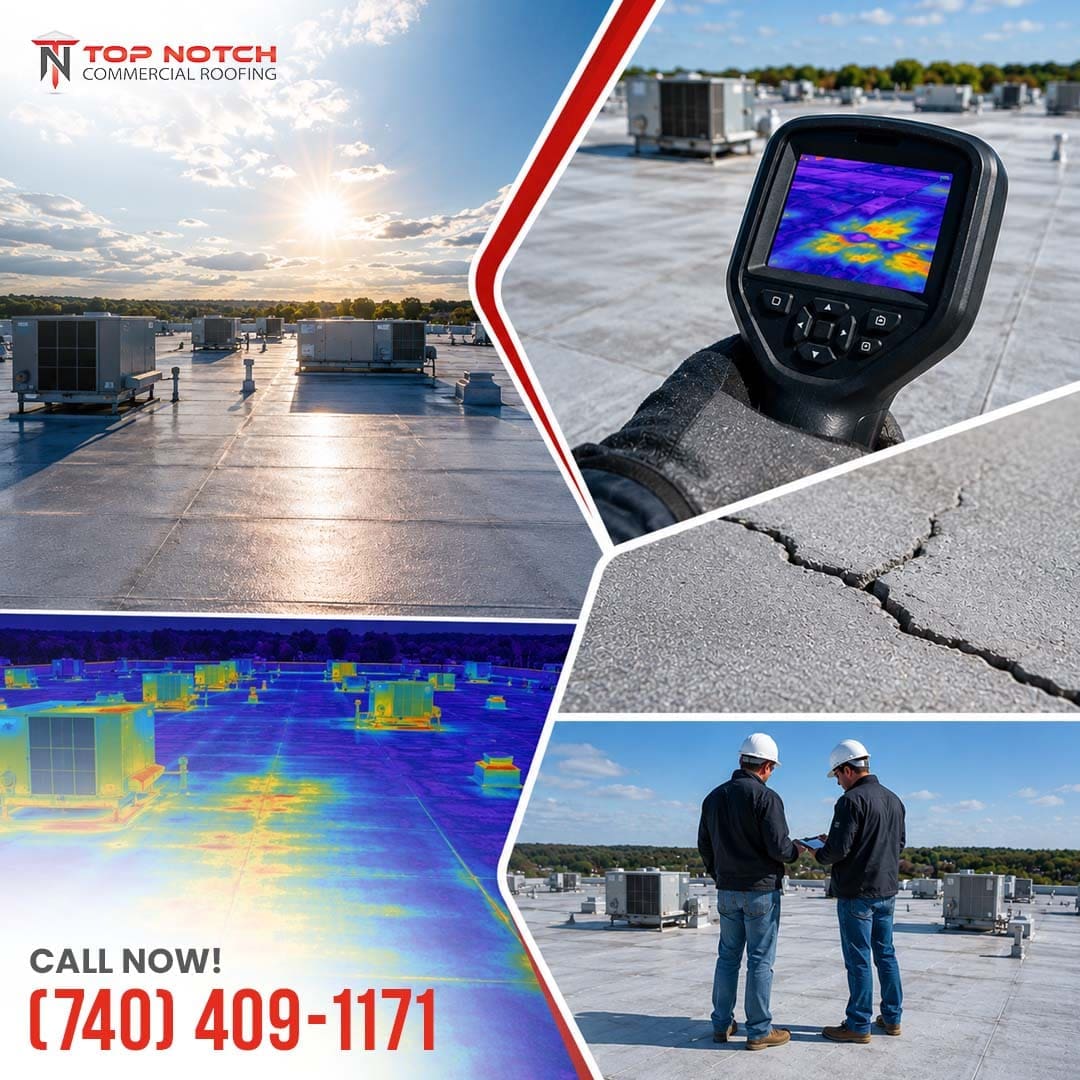
If you want to understand how professional flat roof repair contractors identify subsurface damage before it reaches this stage, our companion guide covers the diagnostic process, including infrared scanning and core cut testing. Top Notch Commercial Roofing uses both methods to map moisture intrusion that visual inspections alone will miss.
A Leak That Looks Minor on the Roof Can Mean Major Damage Below.
The gap between what you can see from your ceiling and what’s actually happening above it is where the real cost lives. Top Notch Commercial Roofing provides certified inspections with honest assessments and zero-pressure recommendations for Salesville, OH, and nearby areas. If your building has a known or suspected leak, call (740) 409-1171 or schedule an assessment online before hidden damage compounds.